

Movement has always been my way of feeling healthy and at home in my body. Over 17years of Pilates, I have felt my strength evolve, but it wasn’t until I became a vegetarian 12years ago, that I truly started thinking about the inner architecture of my body. People oftenasked, “If you don’t eat meat or dairy, aren’t you worried about your bone strength?”At the time, I wasn’t. I felt grounded and powerful through my routine of three to four Pilatessessions a week. But now, in my 40s, I understand the weight of that question. Like thewomen I train in their 30s, 40s, and 50s, I want to age with confidence—staying mobile fortrekking, cycling, and life. We all want to know: Is Pilates enough to keep our bones andmuscles strong as we age?
The Science of Wolff’s Law
To answer that, we have to look at Wolff’s Law, which states that bone grows and remodels in response to the mechanical stress placed upon it. After the age of 30, bone density naturally begins to decline. To slow or reverse this process, the body needs healthy, intentional stress.
Bone is living tissue. It doesn’t respond to effort alone—it responds to directional force. When pressure travels clearly through the skeleton, bone cells receive the signal to reinforce that structure. In Pilates, this happens through:
- Axial loading, where force travels upward through the feet, legs, pelvis, and spine
- Closed-chain work, where the hands or feet are fixed, and the body must organize itself around resistance
- Control over momentum, so load is absorbed with precision rather than collapsed into the joints
This is why alignment matters so deeply in the Pilates method. When bones are stacked, force travels efficiently through the skeleton. When alignment is lost, stress bypasses the bone and lands in soft tissue instead.
Contemporary research in bone health confirms that weight-bearing, well-aligned resistance training stimulates bone-forming cells (osteoblasts) and helps preserve bone density as we age—particularly when practiced consistently. This principle is widely reflected in osteoporosis and women’s health research published in journals such as The Journal of Bone and Mineral Research.
The Chair: Functional Loading and the “Mauritius Test”
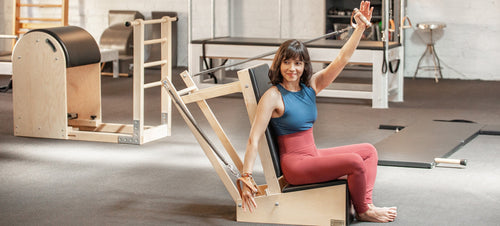
During COVID, the Chair became the only apparatus I could bring into my home. At the time, I was also recovering from a frozen shoulder, and what began as a necessity turned into a discovery. I realized how efficient and demanding the Chair could be—not only for strength, but for rebuilding trust in my body.
From that experience, I began creating a versatile Chair-based program for myself and my students.
In 2025, I used the Chair to prepare a group of women for a Pilates retreat in Mauritius. We knew a hike through the Black River Gorge awaited us—steep, muddy, and unpredictable.
To prepare, we focused on the Chair’s ability to provide axial loading, sending vertical pressure through the spine, hips, and legs.
Through exercises like up-down and climbing the mountain, we trained:
- Center control: managing weight from the powerhouse
- Hip mobility and load management: learning how to drive force through the feet into the floor
- Alignment: In Pilates, where alignment goes, strength follows.
When the “pillars” of our bones are stacked, load stimulates bone growth. The result? These women didn’t just survive the hike—they felt stable, confident, and connected. The Chair’s spring resistance had prepared their skeletal systems for real-life terrain.
The Tower: Closed-Chain Precision
While the Chair offers a strong vertical challenge, the Tower system provides an equally important experience through closed-chain precision. By pushing or pulling against the springs with the hands or feet fixed, we create a direct and intentional line of force into the bone.
This is essential for women in their 40s and beyond, particularly for maintaining bone density in the wrists, shoulders, hips, and spine—areas often prone to thinning. The Tower allows us to strengthen these regions while preserving mobility and joint integrity. Pilates is unique in this way. It doesn’t isolate strength from movement. By training both the agonist and antagonist muscles, we support the skeleton from all sides, keeping the body balanced, resilient, and adaptable.
Consistency Is Key
Life is busy, and many of us try to do everything with the least amount of time possible. But when it comes to Pilates—especially after the age of 30—once a week is rarely enough to create real change. In fact, I often see the body regressing faster than it is rebuilding. Pilates is a practice. The magic happens through repetition, awareness, and commitment. When students show up consistently, they don’t just strengthen muscles—they teach their bodies how to organize, adapt, and support themselves.
In my experience, three to four sessions per week is the sweet spot for maintaining strength and supporting healthy bone density. This level of consistency builds not only physical resilience, but also accountability—to your body, your movement, and your long-term health.
When my students commit in this way, they don’t just feel “toned.” They feel structurally sound. Whether preparing for a mountain trek or simply aging with grace, consistent Pilates practice—supported by the Chair and Tower—provides the resistance and intelligence the body needs to stay strong from the inside out.
Jeanique L. Kalodjera
Owner, Jeanique Pilates Boutique, Dubai, UAE
TPC graduate and License Teacher Trainee
Born and raised in Mauritius, Jeanique is a long-term resident of Dubai, where she runs a fully equipped Classical Pilates boutique studio. With over 16 years of exploring and teaching Pilates, she views the method as a lifelong practice—one that extends far beyond exercise and supports mobility, strength, stamina, and awareness at every stage of life.
Her relationship with Pilates began through injury, a starting point that shaped her understanding of intelligent movement, posture, and the role of the mind in how the body functions. Over the years, this embodied experience has informed her teaching and deepened her interest in how consistent, thoughtful practice builds resilience in the body.
Jeanique is passionate about guiding students toward greater presence and efficiency in their movement, encouraging them to take the principles of Pilates beyond the studio and into daily life. For her, embodying this work is both a responsibility and a privilege—one that continually gives back more than expected.