

Joseph Pilates never explicitly used the word gravity in Return to Life Through Contrology (1945), yet the entire method is built on our constant relationship with this force. In his earlier book Your Health (1934), he stressed the importance of understanding “the principles of equilibrium and gravity as applied to the movements of the body in motion, at rest and sleep.” Gravity is therefore an essential, though often unspoken foundation of Contrology. The method promotes uniform development of the body by engaging with and intentionally opposing gravity through strong, organised and purposeful movement.
Pilates’ corrective exercise system is fundamentally a response to gravitational pull. He warned that to slouch is to compress the lungs, crowd vital organs, round the back and throw the body off balance. In other words, poor posture is a surrender to gravity.
Contrology rebuilds our ability to hold the body upright from the center, coordinating movement so we lift, lengthen and organise ourselves rather than collapse into gravity. Modern lifestyles with long hours of sitting, slumping and screen use, encourage forward head posture and shallow breathing. Contrology counters these patterns by retraining the center to support the skeletal structure naturally and efficiently to restore balance through conscious movement.
Gravity on the Mat
On the mat, gravity becomes the primary source of resistance. With no springs or external load, the body works directly against the constant downward pull. When lying on the back, gravity anchors the shoulders, ribs, lower back, pelvis and heels. In the Hundred, the head, neck and upper back lift into gravity while the center stabilises the pelvis and lower ribs to support vigorous arm pumping. As the legs lift, the center of gravity shifts and demands greater control from the center.
Exercises like the Roll Up and Roll Over require both length and lift to draw the body upward without collapsing the spine. Rolling Like a Ball requires balance through the center and introduces the first inversion as the body rolls onto the head and shoulders, then works with gravity to return to the starting position. In Single and Double Leg Stretch, the limbs lengthen out with purpose to deepen stability through the center.
Seated tall exercises such as Saw and Spine Twist test the spine to stay upright while twisting and/or rounding. The Teaser challenges balance and control as the spine rounds up and the legs lift; constantly negotiating gravitational pull.
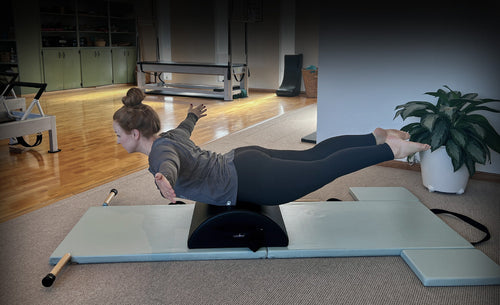
In Swan Dive, Swimming and other arching movements, the mat and gravity work together; the front of the body lengthens into the mat while a strong center lifts the chest against gravity to find the two-way stretch. In Leg Pull Front and Back, the upper body maintains a strong lift as the limbs challenge stability. Side Kicks and Side Bend require lateral control of the center of mass. Both Boomerang and Control Balance integrate complex movements that demand strong control of the body in relation to gravity while challenging balance and inversion skills.
Awareness of Gravity
Contrology is the complete coordination of body, mind and spirit; therefore, the mind must consciously direct the body as it works against gravity.
Awareness is vital because gravity is constant.
We must continuously organise ourselves in response to it.
Teachers can focus on this awareness to help students understand the role of the center in balance and stability. In Swimming, for example, the center, chest and upper back must lift into gravity while the arms and legs alternate in opposition.
Individuals with longer limbs or limited flexibility may find these patterns more challenging. Longer limbs act as longer levers by increasing load, therefore, require more control from the center to move efficiently against gravity. Reduced flexibility can limit one’s ability to organise the body optimally, making the movement less accessible. Bending the knees, or shortening the levers can reduce load, as seen in modifications for Single Leg Circle. Conversely, the Jack Knife intentionally works longer levers, challenging the center by reaching upwards while intentionally pulling down against gravity.
Using the Apparatus to Support the Body
While gravity remains constant, Pilates’ apparatus provides support, feedback and progressive challenge. Factors such as the height or angle of the footbar, use of straps, reaching into poles or handles and varying spring tension all influence how the body organises itself in relation to gravity.
Contrology uses these variables to guide alignment, promote efficient movement and introduce appropriate levels of challenge. Pilates designed his apparatus to support the body’s natural mechanics to allow students to discover lift, length and stability with the assistance of the equipment.
Contrology connects the human body to the natural law of gravity through intelligent, mindful movement. Teachers who embody this principle help students find strength and balance by working with gravity rather than resisting it. In turn, students release tension and discover more efficient, natural movement in everyday activities.
Elaine Kwok
Pilates Teacher
Elaine Kwok is a New Zealand-based Pilates teacher with 25+ years of movement teaching experience. Certified through Authentic Pilates and informed by Jay Grimes’ lineage, she teaches the method with original integrity, guiding students and teachers – both in studio and online, to move with strength, clarity and vitality for whole-body health.
Website: www.upgradepilates.co
Instagram: upgradepilates_studio