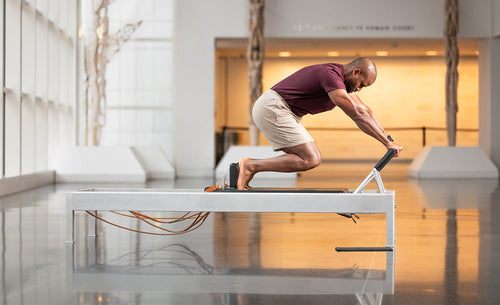


I am a classically trained Pilates teacher, and I occasionally come across posts on social media suggesting that classical Pilates is rigid, repetitive, or even boring because of the order. I understand why people might think that from the outside, but after more than 20 years of teaching and studying the method, I see it very differently.
To me, the classical system is anything but limiting. In fact, the deeper I go into it, the more creative it becomes.
Why I Love Classical Pilates
I stumbled into classical Pilates training by accident. At the time, mat Pilates was everywhere. Classes were popping up in gyms, yoga studios, and recreation centres. I had Pilates DVDs that came with my baby’s formula and those little Pilates balls you could fill with rice or sand that were gifts in cereal boxes.
It just so happened that the teacher training program closest to me was classical. There were only a handful of programs in my area at the time, and I signed up without fully understanding the differences between styles. I learned that there was an order to the exercises on the mat and reformer, and that every other apparatus existed to support the body where it needed strength, mobility, awareness, or connection. Over time, I tried all kinds of Pilates classes and workshops, yet kept coming back to classical Pilates. The structure of the classical system seems to suit my personality, and it makes sense to me that each exercise prepares you for the next.
The more training and education I’ve experienced over the last 20 years of the classical Pilates system, has me feeling more and more like I need more time in the studio. I want to do it all, and I know there is so much more to explore.
Creativity Comes With Practice
The better you know the full classical Pilates system, the easier it becomes to be creative with your students. Your clients’ bodies begin to tell you what they need. For example, I’ve been teaching a group class with everyone working on the same apparatus. Then as a finisher, I may give each person a finisher specific to their body.
There are endless ways to stay creative while still respecting the order and principles of the method. At our studio, we work with reformers, towers, chairs, and mats - enough equipment for each client to fully experience the system. And while many clients absolutely love tower and Cadillac work, I still enjoy changing things up to keep classes engaging and challenging.

Keep Things Fresh
One of my favourite things to do is take the mat order and teach it on the Tower/Cadillac or the Wunda chair. Or you can take the reformer order down to the mat for a fabulous challenge.
Alternating between the mat and apparatus exercises is a great way to switch things up. By doing the mat version then the tower version of an exercise, for example, clients can start to notice the similarities and differences. Try doing mat roll ups, then bar roll downs, or standing roll downs. Try single leg circles on the mat, then do the leg spring version. There are so many fun pairs to try.
Finally, try using a wall for some of the mat exercises. You can lean against it or use it as a tool to help learn the reach of the legs. It’s also a great tool to provide modifications and find deeper connections.
Incorporate Themes
Themes are another great way to keep a class interesting while staying within the classical system. You don’t need to reinvent the workout, just change what the clients are paying attention to or how you talk about the exercises. Here are some of my favourite themes:
1. The Feet: As you go through the class, have the students be very aware of what they are doing with their feet in each exercise. Are they connecting into the equipment fully? Do they roll their feet out or in? Have them note that this exercise is pointed, this one is flexed, and so on. The smallest change in how the students use their feet can change the impact and effectiveness of an exercise greatly.
2. C Curve: Point out the C curve in the hundred and all the way through the class. Forward flexion is one obvious way that we create a C curve, but we are also doing the same in a side bend, and in extension. Helping students be aware of the uniformity of their C curve and so on.
3. Breathing: A focus on breathing can transform an entire class.
4. The Two Way Stretch: This helps clients understand opposition and length through the body.
5. Twists & Bends: Explain how non-twisting or bending exercises prepares them for upcoming twisting or bending movements.
Change the Class Structure
You can also work with the structure of the class to help your clients find a different focus.
1. Reps: A 1-rep or 3-rep mat or reformer can be fun and challenging. You could do both, or you could use the one as a warm up then go and do a full workout on the other apparatus.
2. Countdown Workouts: Select a group of exercises and do a countdown workout. I have taken 10 or 12 foundational level exercises on the mat, start the students with a bit more explanation and 5 or 6 reps of each, then go through the same exercises with 4, then 3, then 2 and 1 rep of each.
3. Start to Finish to Start: Do the workout in order from start to end and then from the end back to the beginning.
4. Lighter Springs: Reduce the springs on some of the reformer exercises (where it is
safe to do so) and challenge the clients to control the carriage. I love to do this with the footwork, then move on into the regular workout. This can take a good few minutes of the class so it can be the one unique thing you do in the session and then you move onto the regular order.
5. Revisit the Foundations: Go back to the foundations in order to build back up to the advanced work. I find that longer term students who are at a more advanced level can benefit from going back to the beginning and really honing in on their technique. They find it hard even though the exercises are less complex.

Give a New Focus
Giving your students one new thing to think about in a class is a great way to keep them engaged and thinking. Too many things to think about can be overwhelming, but that one thing will stay in their mind the next time they come to class. I’ll even notice that they ask about it later or if they are doing “it” better. This is where you can now add another new thing or just let them work on that last theme or idea for a few sessions before adding more.
Creativity With Purpose
I love Pilates. When I discovered it, it became the missing puzzle piece to my fitness routine. Whether you teach classical Pilates or another style entirely, creativity should always have purpose behind it. The goal isn’t to reinvent the method, it’s to help clients connect more deeply to their bodies and understand the work in a more meaningful way. And in my experience, the classical system offers endless opportunities to do exactly that.

Melissa Nagai
Melissa Nagai is the founder of b.Pilates & Fitness, where she helps active adults build strong, resilient bodies that support the lives and sports they love.
She began her fitness career at 23 while studying interior design, first as an aerobics instructor, then as a spin teacher and personal trainer. In 2006, she earned her mat Pilates certification, and in 2008 entered her first comprehensive teacher training under mentor Emmie Li — an experience that shaped her foundation in the Pilates system.
After years working in gyms and studios, Melissa took a leap into ownership, opening b.Pilates & Fitness with just two reformer/tower units and mats. Her commitment to mastering the work has never stopped. She continues to train weekly with her own teachers, works with strength and running coaches, and travels regularly for workshops and conferences.
In 2022, she launched the B.Pilates Classical Pilates Teacher Training Program. In 2024, she completed The Classical Progressions Program with Karen Frischmann, who studied primarily under Jay Grimes and also Romana — further deepening her understanding of the Classical lineage.
Melissa specializes in helping active adults from their mid-30s to mid-70s stay strong in their chosen activities. Using the Pilates system as both pre-hab and rehab, she delivers intelligent, corrective programming that also happens to be a challenging, full-body workout.
Outside the studio, she stays active through running, hiking, biking, skiing, and paddle boarding. A former Scottish dancer who has always loved sport and creativity, she believes in saying yes to new challenges. She and her husband have three adult daughters and cherish family gatherings, travel, beaches, mountains, and discovering cozy coffee shops along the way.
WEBSITE:
Social media:
https://www.instagram.com/b.pilatesandfitness/