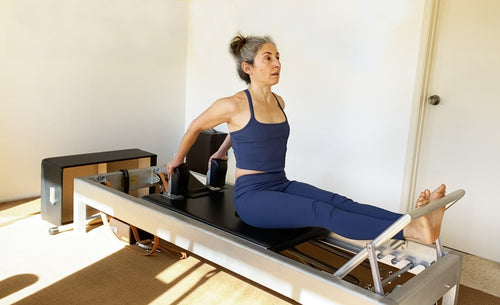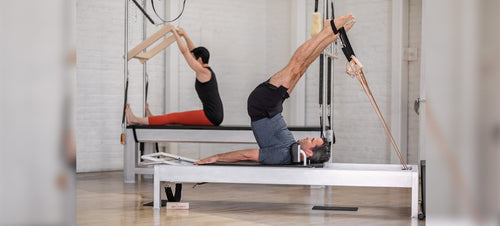


My journey through the treatment and recovery for stage IV lymphoma solidified my belief in and love for the classical Pilates method. Reflecting back, my disease and recovery process put every principle of Pilates to the test, which is true testament to the power of this work.
I originally found the classical method in 2018 after completing a comprehensive contemporary training. I was confused about Pilates and still suffering from chronic neck pain. Within just a few classical classes I realized I had huge gaps in my understanding of Pilates while simultaneously experiencing drastic improvements in how I felt physically. I was sold. I’m forever grateful to my first mentor, Jennie Rathke.
Since then I have stayed true to the method despite making multiple cross-country moves and teaching at a variety of studios from California to Georgia to Montana and now, Colorado. Everything changed in early 2025 when my health took a drastic downturn. What initially seemed like walking pneumonia quickly devolved into crippling fatigue, shortness of breath, and unexplained pain. After two fruitless doctor visits, I ended up in the ER hearing the words: “It’s cancer.”
A collapsed right lung, liters of fluid in my chest, a pericardial effusion (fluid around my heart), and at the center of it all, a large tumor. I was at a loss; mere months before I was hiking mountain trails and now here I was, on oxygen in the hospital. How could it have happened so quickly?
Just my luck, it turns out mediastinal B-cell lymphoma is especially aggressive and likely formed inside of a year. The treatment was equally as aggressive: six 5-day stays in the hospital over about four months receiving continuous chemotherapy. I chose to receive my treatment at UC Health in Aurora, CO which meant that literally overnight my life was moved from Montana to Colorado.
My body felt completely foreign to me. My right side obliques and intercostal muscles were overstretched from the liters of fluid that had collected in my chest. I had two incisions on my ribs for chest tubes. My posterior chain strength was non-existent after my initial 3-week stay in the hospital, my balance was off, and I was completely disconnected from my breath. I had rapidly lost about 30 pounds and experienced muscle atrophy. The path ahead felt daunting but as soon as I understood the reality of my situation, I committed myself to maintaining a positive attitude and abiding by the principles of Pilates that have shaped my lifestyle over the past eight years.
Breath
Not being able to take a full, deep breath is torture. As soon as my right lung was able to expand again, I felt immense relief, but the road to full recovery is one I continue to walk. Returning to the principle of breath was innate and encouraged. The hospital-issue incentive spirometer is quite similar to a Breath-A-Cizer and I used it to practice extending my exhales. I also regularly practiced Hundred breathing– anywhere from laying in my hospital bed to pacing my breaths with my slow and measured steps rather than the pumps of my arms. The familiar rhythm not only challenged my breathing but also helped to ground me in moments when anxiety threatened to take over.
Precision
As soon as I got my chest tube removed after about two months of severely restricted movement, I booked a private Pilates lesson. My body felt so foreign and I had lost so much strength, I knew I wanted trained eyes on me, guiding me back to movement. To complicate matters, I had a PICC line in my right arm for the entire duration of my treatment. This meant I couldn’t reach my arms behind my body or too high overhead and I couldn’t lift more than 10 pounds. I found a wonderful teacher who has also become a friend and colleague. With her guidance, I trusted that my movement was precise and safe.
Concentration
My mind-body connection was totally interrupted by the extreme and traumatic nature of the situation. Add to that the intense fatigue and somewhat absent minded state that chemotherapy puts you in, my one hour a week at Pilates became what I looked forward to most. The solid support from the equipment, the familiar tension of the springs, and the opportunity to have an internal conversation with my body... Can I breathe into the right side of my ribs a little more? Can I find my balance firmly on one foot? Can I invite a little more space into my side bend? Having those pockets of focused concentration between my arduous chemo treatments helped me understand my new weaknesses and how I would need to strengthen them.
Centering
My loss of center has been one of the most interesting aspects of this experience. While I understood the tight and tender oblique and intercostal muscles, I was surprised at how much the weakness extended up and down the entire right side of my body. The strength and balance in my right leg was severely affected and after months with a PICC line, my right arm was also weak. Focusing first on building my powerhouse strength with smaller, controlled movements like half roll-backs, hip bridges, and arm arcs helped me to reconnect with moving from my center and rebuilding the strength and balance on my right side.
Flow
Because my stamina was so low, I reverted to the basics in my self-practice. Initially I focused on the beginner mat order, challenging myself to move through all the exercises without stopping, being mindful of transitions and squeezing the most out of each exercise. Finding flow during a time of uncertainty was both comforting and encouraging. Once I plateaued with the beginner exercises, I knew it was time to progress to intermediate and so on. Focusing on flow helped me find my rhythm and the endorphin rush that reminded me of my vitality.


Control
By the time I finished chemotherapy and got my PICC line removed, I was looking forward to returning to a more regular self-practice at home in addition to my private lessons, but my body was still tender and the thin roll-away mat that I had was not enough cushion for my sensitive spine. I decided it was time to start rebuilding my collection of equipment at home, but my space was limited. I ultimately decided to go with the Contrology Folding Mat, Wunda Chair, and Spine Corrector.
In addition to the thicker padding, I wanted the resistance and support of an ankle strap and dowels which have given me more control as I progressed through my intermediate practice and back to my advanced mat practice.
I’ve always loved the Wunda Chair and it provides the balance and stability challenge that I need. The fact that I can flip it over and throw a few cushions on it if I need additional seating is an added bonus!
Everyone loves the Spine Corrector for that delicious extension and after not being able to backbend or stretch open my shoulders for months and months, it has been the most joyous addition to my at-home practice. I do roll downs and side bends on it just about every day.
This whole experience has made me so appreciative of the method that has had my back for years now. Because Pilates was so integral to my recovery process, it really made me a believer in how helpful this practice—no matter the level—can be in helping people feel strong and secure in their body after illness or injury, burnout or trauma. Pilates reminded me of my strength at my very weakest.
I also experienced a renewed vigor in my teaching once I was ready to return to the studio. I found so much inspiration from spending time solely as a student that I decided to enroll in a mentorship program with Brooke Bergdahl this year called Return. Focusing on being a student has accelerated my progress and keeps me motivated, inspired, and curious in my work with clients. The future looks bright.


Caitlin Sullivan
Caitlin Sullivan is a comprehensively trained Pilates teacher who has mentored under second generation teachers, Jennie Rathke and Brooke Bergdahl. She also studied holistic hormone health at the Institute for Integrative Nutrition and fertility awareness method through FEMM.Caitlin created the Spring to Life Method to merge her passions for Pilates and women’s health.She teaches in Denver, Co and hosts transformative Pilates retreats.